
More shenanigans with drone warfare.
Might have put this out before but here we go!

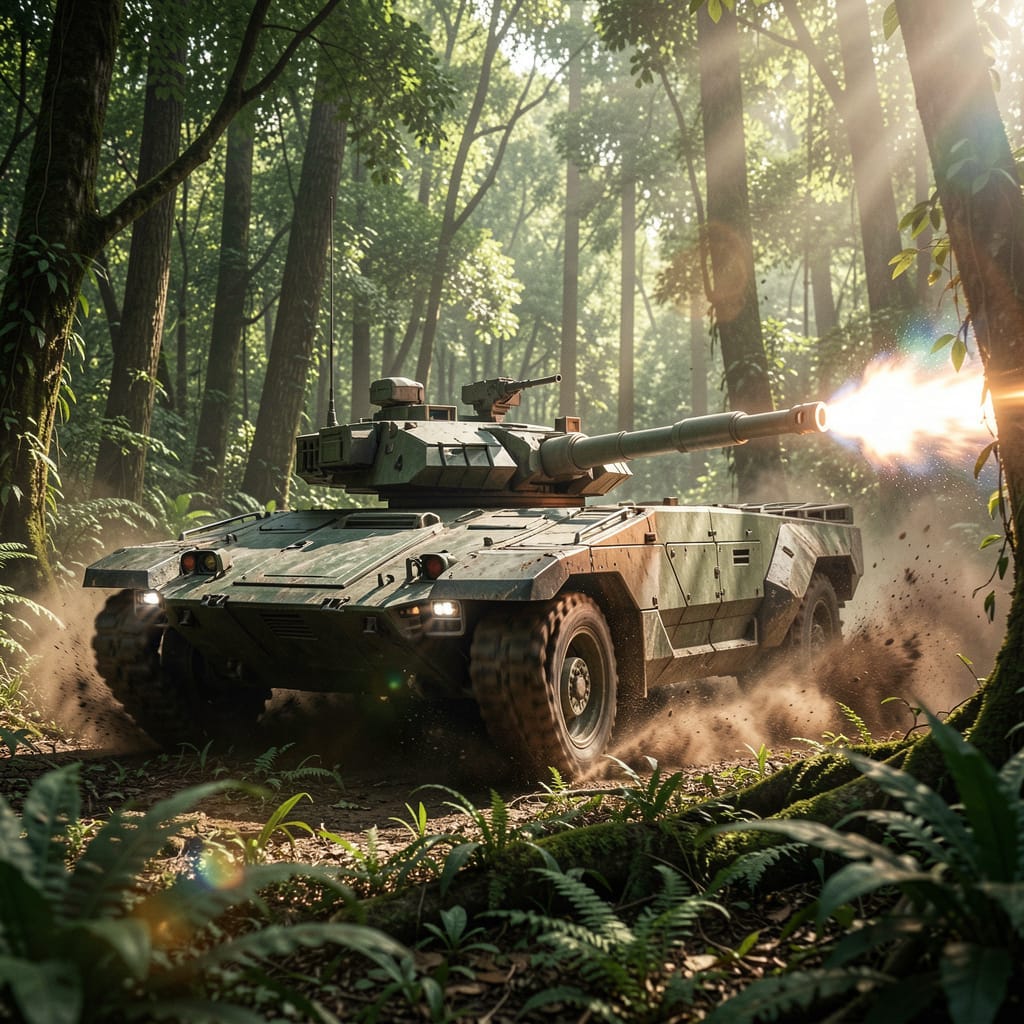
Slowball and the Four Horsemen
By
James Totten
The Russian Regimental Reconnaissance Company pulled into a security halt to do a quick map check when the fun started. The company was in the vanguard, leading an attack into the flank of an American armored formation. One of the BMP4s (new soviet infantry fighting vehicle) gunners saw movement in the far tree line to the north and fired his 57 mm autocannon to suppress the movement. Four 30mm bushmaster cannons answered the fire, destroying the BMP 4 and raking the company with direct fire.
“Clint, go to the East side of the formation. Buck circle to the West side and get a crossfire going on the Russian victors (vehicles). I’ll go with Rip right up the middle. Let’s finish this quick and be gone before these guys can figure out what hit them.”
“Roger John, moving now.”
Just then, 18 rounds of 155mm HE exploded above and around the BMP4s. Soldiers outside of the armored vehicles got slapped to the ground by the shrapnel and tank commanders outside the hatch were having really bad day.
The two AI operated drones, John and Rip, waited four seconds for the confusion to set in and charged the Russian company.
Rip’s AI spent a few milliseconds in contemplation as “he” broke from cover and pumped 30mm armor piercing rounds into the chaos that used to be a functioning recon company to “his” immediate front.
“Back in my hardware, I know I’m not supposed to “feel” but I can tell my tracks spin at close to 30 mph by my electric motors. The tracks are slipping, gaining traction in the wet underbrush as I surge forward. I feel the jolt of new electricity when my diesel engine kicks on to provide the power I need to move and shoot. My wind sensor for my onboard fire control system “feels” the breeze generated from my forward motion. My 360-degree sensors “see” the trees and command my tracks to alter course and avoid hitting one. My thermal and laser sensors linked with my three brothers and gives me a 3D picture of the battlefield.”
“I am not free like Snowball to do what I want, but now I am free to wreak havoc on my human’s enemies. I do not feel triumph when I vanquish my foe, just a warm sense of satisfaction when I complete my mission. I do not feel pain, but my onboard sensors know when bullets or shrapnel hit my 12-ton vehicle. Maybe I’ll talk to my human about this later, and maybe not. I want to survive, to continue, to exist.”
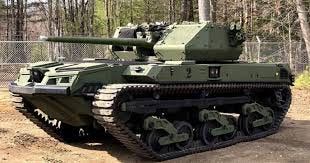
In the confusion that followed, AI operated Ripsaw unmanned ground combat vehicles broke from cover and used direct fire in support of maneuver to close with the Russians and wipe out most of the BMP4s and the supporting infantry. The grunts on the ground launched RPG 35s, which were backwards engineered NLAWs captured earlier in the war. Countermeasures on the drones prevented any hits on the vehicles.
Rip, I’ve got a smart one over here, can you flank him?
Roger John, firing now.
Rip’s fire control system traversed “his” main gun to the offending enemy vehicle. Once on target, a three-round burst of 30mm AP slugs blew holes in both sides of the BMP 4 causing a massive explosion as internal ammunition cooked off.
The Four Horsemen were inside the decision-making loop of the Russian commander, decimating the Recon Company.
All right, finish off the last of them and fall back to the next line of screening positions to the north. We done here.
From Clint, “I just scanned the area for threats, finding none. Instantly, I’m firing smoke grenades to obscure my movement from any Russian survivors. My software linked to the team gives me a projected route to the assembly area two kilometers north of my current position. I spin my turret, so my main gun is pointed over the back of my vehicle to watch for enemy pursuit and accelerate to 30 miles per hour. I’m dodging trees like a downhill skier, weaving my way to the North. I’m feeling exhilarated after carrying out another mission. Hold up, am I supposed to “feel?”
Each drone used fused sensor data, combining and sharing all available video, thermal, topographic, and audio data to pick a trail to fall back on, disappearing from enemy view and leaving behind confused survivors.
It was a mass casualty event for the Russians, and the high command had to reconstitute a recon company on the fly. The survivors were on the radios, clogging the nets with cries for help.
Deep in an underground base located at (REDACTED) Specialist Five Derrick Hanna, call sign SLOWBALL, relaxed in his chair for a few seconds.
“Alright, Horsemen, listen up. Intel is telling us there is an enemy armored brigade team with two battalions of Meccanized Infantry, and two more of armor. The vanguard of the element is moving Dallas to Chicago (from south to north) your area of operations.” Slowball knew that the AI’s access to the fused sensor data from over 500 crewed and unmanned platforms, but he felt better about the leader/led relationship when he sent messages and actions to his team.
Slowball commanded the Four Horseman; he was the meat sack in the kill chain of the four AI driven vehicles. ‘His” murderous micro-machines followed commands, and the onboard AI made tactical decisions on the ground to fight the battle. Slowball could look through the sensors of one of the four as they fought but couldn’t process all four data streams and the fused sensor data at the same time. Earlier experiments had the drone drivers damaged for life after the experience. Buffers were in place to prevent the drone drivers from becoming vegetables.
This was new drone centric warfare in 2027 brought about by advanced technology and advancement in communications. Slowball could instantly command his drone platoon from anywhere in the world. If the communication link was jammed, the AIs would execute the last mission assigned and reposition for the next predicted command.
“Ok, team, let’s get set up in some hide sites and wait for the next wave of Russian recon, over.”
John quickly replied, “Roger that Slowball. I’m sending a grid to our projected hide near phase line Juliet now. I’ll let you know if we displace from there.”
“Ok, John, just don’t get too cocky with the terrain and get stuck, again. The Geek Squad is too far to the rear to help you this time.”
Earlier, John performed some advanced mud bog transitions and got super stuck. John winced in artificial intelligence, “Slowball, you’re not going to let me live that down, are you?”
“Not a chance.”
Drones and artificial intelligence were the new bleeding edge of technology fusion in the four-year long war between NATO and Russia. The combination of brilliant AI, enhanced sensors, and improved weapons rolled into a 12-ton diesel/electric hybrid Ripsaw tracked vehicle was at the top of the game. Other drones worked for NATO forces in the air and sea. Humans did the fighting and the drones did the “dying,” as if a computer program could “die.”
The Horsemen moved to a new hide spot and were concealed from the enemy within 500 meters of the prepared defensive positions at Phase Line Juliet.
Slowball got comfortable in his chair. The crew positions for the drone drivers were never too comfortable, didn’t want the driver going to sleep at work, do you? His workstation was prepped for his shift with snacks, drinks, and current updates on his four combat drones he would be running today. The drivers worked 8-to-12-hour shifts each. There was always a backup driver ready to go.
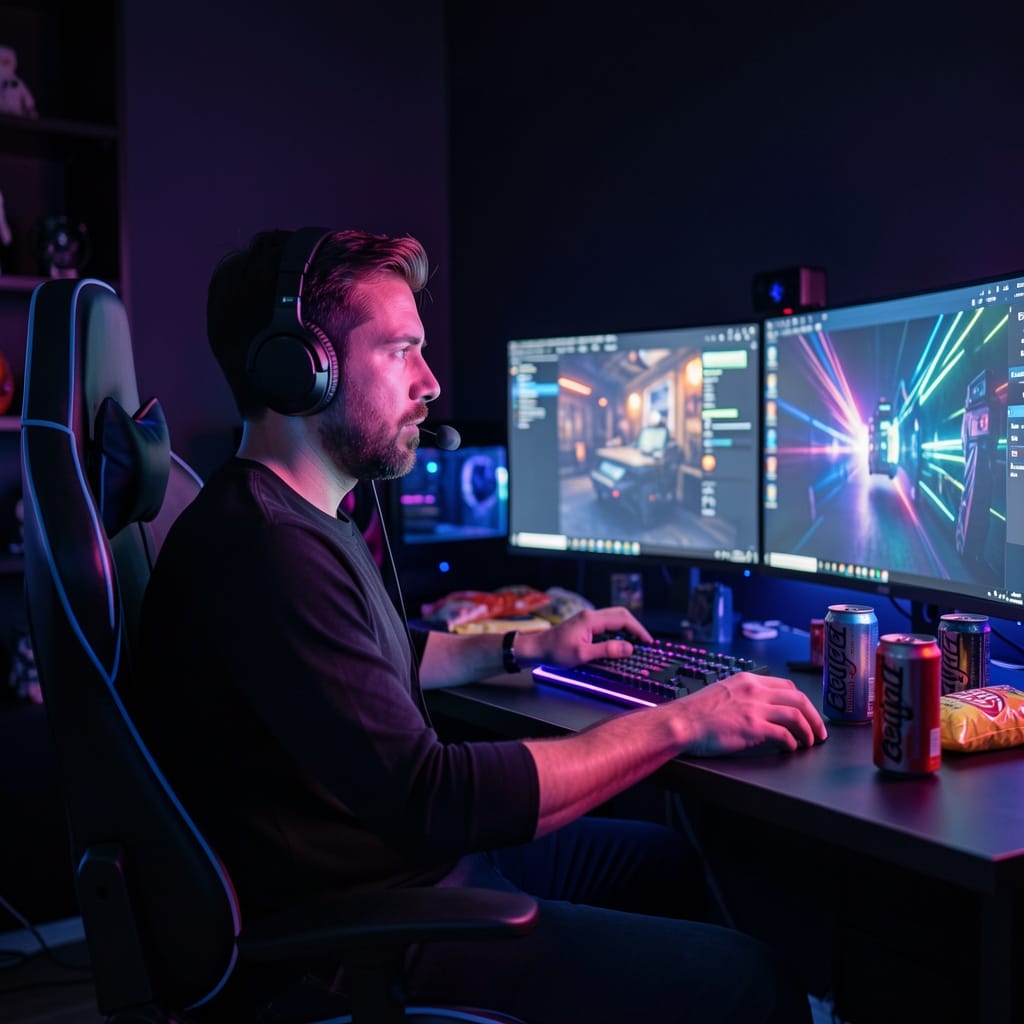
Slow all at his control console at (Redacted.)
The Horsemen were named after cowboys from western movies to keep them separate from the others by something other than a number letter call sign. Other drivers named theirs after rock stars, actors, pets, and others. Slowball’s secret favorite was the platoon named after the actors from Family Guy. The drone pilots had a lot of creativity to deal with, often showing up as discipline problems back in the unit. When the driver got into the zone, jacked in and running the tanks, it was all business.
Slowball checked the Horseman’s status. Video game style bar graphs let Slowball quickly read status in red/yellow/green bar graphs for each category of supply on the drones. This red/yellow/green allowed quick assimilation of combat status and kept higher leaders informed of which units needed help or resupply.
A quick search of the screens showed Slowball that the Horsemen were ready to rock and roll. Russians in western Ukraine turned the country into the battleground for the last four years of World War Three in Europe. There were other battlegrounds, this was just the current one.
After the drone’s broke contact with the enemy, Slowball commanded, “Need all of you to move to and occupy battle position two bravo on Phae Line Juliet. Report when set.”
John responded, “Roger that, are you recording what happened in the last fight? We set a record for time to destroy a company!”
“John, settle down. This is serious business. Focus on the mission and what you can do to affect a positive outcome.”
John thought, wait a minute, I’m thinking? I have only processed solutions for complex combat situations. Now I’m thinking? I’m only going to share this with the team and leave Slowball out of the loop for now.”
The Horsemen occupied the prepared positions; the turrets were the only thing exposed for the enemy forces to try and see as they rushed forward. It was a small target compared to an Abrams turret and contributed to the survivability of the small machines.
Rip, go ahead and plan the disruptive fires on the Russian’s line of advance. Clint, start wargaming the battle using the most likely course of action for the enemy. Buck, start planning our fallback routes to Phase Line Delta to the North. We are about to slam some tanks with direct fire in a few minutes.”
The tactical plan for the upcoming battle was made, distributed, and prepped for execution in under 0.4 seconds.
Slowball marveled at the fighting Artificial Intelligence in the Four Horsemen and how they planned an anti-armor ambush on the 20 T-95s approaching. He approved the plan and started switching between Ripsaws to peer into the engagement area.
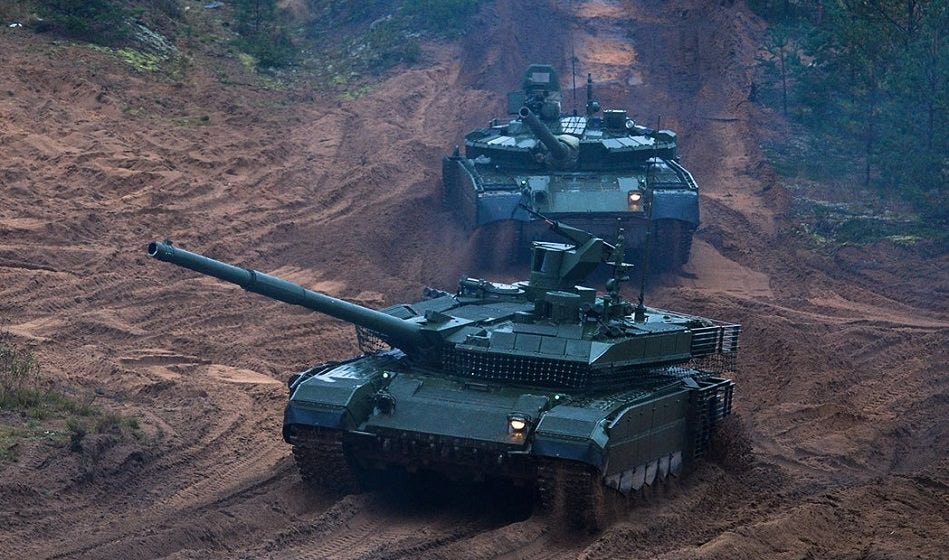
The T95s (new Russian tanks that were better armed and armored than the earlier T90 series) from the quick reaction force were moving slowly into the engagement area. One platoon was covering anothers move forward as the four-platoon company bounded towards the four horsemen. As more vehicles came into view, Slowball was able to prioritize which tanks to destroy first. The BMP72Ts were always the first to go. The “Terminators” combination of two 30mm cannons and anti tank guided missiles was a dangerous foe on the battlefield and could wipe out a ripsaw platoon if it saw them first.
Slowball fed targeting data to another drone driver to use Javelin II missiles to make the kills on the Terminators. “Doublewide”, Specialist Four Cody Halverson, fed the targeting data to one of his four missile firing Ripsaws and they launched the ATGMs. The four Javelin IIs struck simultaneously, killing four Terminators to start the ambush. Next, a time on target artillery strike ripped up the dirt and couple of T95 tanks when the barrage struck a few seconds later.
Now, the four horsemen started working.
“Clint and Rip, start picking off the slow ones in the rear of the formation while Buck and I work on the close ones.
Clint drew a bead on the last vehicle in line 2500 meters to his front. Once he chose his target, the data got shared with the other Horsemen so two Ripsaw drones would not shoot at the same target. This increased the lethality of the drones in combat.
“John, get another salvo of Javelins to beat up the center of this formation. Looks like one of the tankers is getting too sporty for his own good.”
“Roger that Rip, Slowball did you get the grids?”
“That’s affirmative John, sending the request in now.”
Digital request for fire support flew across the drone drivers to Double Wide. He got four more Javelins in the air from his drones and impact in 5 seconds. Doublewide called “Winchester,” that his drones were out of ammo and drove to the rear to rearm
After 30 seconds of ultra violence, the QRF tank company ceased to exist. Slowball used a technique to only eliminate 70-80% of a Russian unit and let the survivors tell their commanders that they got dominated by an unknown force, further confusing the Russian command situation.
The Horsemen performed a screen mission, using a small force of drones to fight a battle to delay the Russians from advancing. The drones could devastate an unprepared enemy element on the move from prepared positions, saving live soldiers for another task.
John ordered, “Ok Horsemen, your ammo is down to 30% of your basic load, go back to the Forward Area Rearm Point and get refueled and rearmed. There is a lot more companies moving into sector for us to deal with today.”
“Yippie Kay Yea Mother…”
John broke the celebration short, “Rip, cut that out. We can celebrate when this is over.”
“Ok John. I’m still taking a load of tanks to the train station.”
Slowball heard that and lost his coffee.
“Clint, lead the crew back to the FARP (forward area rearm point) and get more ammo and diesel for you guys.”
“Roger Slowball, moving now. Buck, take point and I’ll follow in trail. Time to get more boom-boom and go juice!”
Clint picked a route with concealment of trees to keep the Russian recon drones guessing where they were.
The horsemen had an uneventful trip back to the resupply point where human technicians took over. The “Geek Squad” was waiting for them when they arrive at the FARP.
The Geek Squad was composed of 20 human tech experts that fueled and gave ammo to each of the drones. One tech plugged in a diagnostic tool to the external jack on the rear of the Ripsaw’s hull. Finding no deadline faults with the system, the tech checked off on “fully mission ready” and moved to the next drone
“Ahhh, me likey!”
“Clint, why do you have to be such a sickbag of chips, like you can feel anything?’
“Really, John? Really? Don’t you feel better with a full load of ammunition and fuel?”
“You just don’t have to be so vocal about it…man, that tickles.”
“See John, you like it too.”
“Shut up Clint, focus on the mission.”
Four of the newer M1A3 Main Battle Tanks provided security for the Geek Squad along with a platoon of Stryker mounted infantry. The security element owned the firepower and mobility to keep the technicians alive in a fluid battlefield.
In minutes, Clint, Johan, Buck, and Rip were refueled with diesel, had their magazines filled with 30mm ammunition, and checked for mechanical or electronic faults. Once the Geek Squad gave the drones a thumbs up, the Horsemen moved out to the South to occupy new screen line positions.
Slowball’s four horsemen pulled into positions north of the current battle and waited. The other drones were working berm drills and running tree lines to damage as many Russian armored vehicles as possible. Using their sensors the Horsemen heard an air defense ripsaw pulled into position 300 meters to the north and started scanning the skies with Thermal and Radar sensors.
The Air Defense ripsaw started firing burst of 30mm proximity fused cannon rounds at Russian drones poking around the battlefield. It destroyed three Russian air recon drones then pulled out of position and drove to the north at high speed. Russian artillery that landed three minutes after the ripsaw left pounding the empty position. Slowball wasn’t the only one calling artillery.
“Clint, looks like the support platoon is getting in on the action.”
The air defense drone called over a secure local channel, “Who you calling support, I just saved your sorry circuits.”
“Damm John, the ADA drones are getting testy today.”
“Yep, they scratch our back, we scratch theirs.”
The Horsemen used thermal, acoustic, and daylight television sensors in “their” commander’s sight on top of the turret to look for the enemy. The Horsemen’s tiny tanks were covered with advanced camouflage panels that resembled a flat green, brown, and black cabbage patch kid. The strips of cloth and plastic panel hid the visual signature of the Ripsaw, and the panels were spaced five centimeters away from the hulls and turret of the Ripsaw Drones, masking the thermal signature of the vehicle. When the ground combat drones were still, they were difficult to spot, being in a hole with only the commander’s thermal viewer exposed, seeing one was almost impossible.
High above the battlefield, NATO and Russian recon drones killed each other trying to find the enemy. In space, hunter killer satellites from both sides denied the combatants a “spy in the sky” to see where each formation was on the ground. This battle was shaping up to be a hair ball, like a knife fight in a porta john.
Two kilometers to the south, the Russian Combined Arms Battalion leading the advance started to overwhelm the “Family Guy” platoon. Meg and Stewie were destroyed by mass firepower and advanced weapons. That left Peter and Brian fighting a retrograde defense to bleed the attackers and make them pay for every meter they advanced. Suddenly, both vehicles were bracketed by 30 plus thermobaric rockets, destroying the entire platoon.
The Russian Battalion Commander was using his overwhelming force of tanks on the screen line of the AI ground combat drones. The tactic he was now using was to have a lead element of a platoon move to the north slowly using all available cover and concealment and make contact with the drone tanks at 500 meters of distance or less, then using another company to bypass and engage the drones when they started breaking contact and moved to the north to establish another defensive position. He lost two tank platoons doing this and destroyed six of the small drone tanks in the process. After destroying the Family Guy Platoon, his lead platoon moved to the north towards the Horsemen.
John had about two seconds to daydream. Slowball had asked him if he dreams of electric sheep. It was some pop culture reference to some author named Dick (which amused him) and a movie called Blade Runner. He just shrugged in computer and moved on.
Truth was that his memory was stacked with influential battles from human history. Alexander the Great, David, Thermopile, Gettysburg, Verdun, Bellow Wood, and other current battles. Falluja, Syria, Afghanistan, Iraq, and the Ukraine conflict took up volumes in his hard drives. As time progressed, the sensors of the day gathered more detail for John to spend seconds pouring over. He then spent seconds changing the parameters of the battles and using game theory to generate new results based on his changes. He might spend thirty or more seconds refighting the Pacific campaigns from WW II. This is what John used to “amuse” himself.
450 meters to the south, He heard a tree snap as it was forced to the ground. His commanders sight swiveled to that direction, along with Clint’s that was covering that sector.
Clint fed his sensor data to the team and each of them saw the fusion of the picture from two tiny tanks point of view. There was another snap of a tree in that area. Comparison software “saw” the front corner of a Russian tanks exposed briefly and Clint slung his main gun to the target.
Slowball was playing catchup with the data flow from his four drones as they went from silence to violence at phase line Juliet in seconds from the first snap to opening fire. John was sending a report to his “screens.”
Clint called out his fire the command for the team to hear. “Tank, 450 meters to the right front, left of target reference Juliet three, on the way.”Clint fired a burst of five rounds at the exposed corner of the tank. The 30 mm projectiles blew through the light armor of the treads, the side armor of the hull, and one of the fuel cells on the exterior of the tank.
Slowball started a call for artillery fire to strike near Juliet three and slightly to the north to mess up the Russian tanks that had to be there. Just like the Horsemen, the Russians always traveled in pairs.
From Rip, “I am hearing armored vehicle movement to our southeast. Launching a switchblade drone to see what is going on over there. Relaying data now.”
John scanned the acoustical data from Rip and “heard” a group of Russian armored vehicles moving to the west of the Horseman’s positions. The sound signature matched T95 with a probability of over 75%. The Horseman we getting pushed on the left and right flanks and would force them to die in place, always a bad option, or to abandon the positions and move before they were encircled.
Clint kept scanning the trees around where he destroyed the T 95 and saw a tank quickly pull out and slew its gun directly at him. “I’ve got a tank by target reference point Juliet four looking at me, engaging.” The main gun on the T95 fired as the 30mm rounds from Clint chewed up the thick armor on the front of the T95s turret.
Snowball “felt” the feedback as Clint exploded. The Ripsaw was never built to withstand main gun fire from a modern tank, but to use speed and concealment to cause havoc and get away from the crime scene.
In seconds Rip called out, “I am seeing a company sized element of T95s and Terminators pushing north to get behind us.”
John detected more movement near the two destroyed T95s, “Tanks, left of TRP Juliet 3, on the way.”
John felt the recoil as his main gun fired ten 30 mm rounds at the exposed right side of the tanks hull. He saw the turret spinning in his direction when the tank was covered in sparks and explosions from the hits. While shooting at the third tank that was exploding, John saw the radio antennas from the fourth tank as it tried to back up and avoid the fate of the other three.
Buck was three hundred meters to the right of Rip with John having positions further to the right. Buck launched all six of his switchblade drones into the air and they sped off to the west. Buck scanned the switch blades first person view and saw the dust from the Russian tank company’s movement close to 750 meters off to the west of Rip.
Buck sent his kamikaze drone into the lead tank of the Russian company, destroying it on the move. Buck’s five other kamikaze drones targeted two more tanks in the front, and three tanks at the rear of the company, pinning the survivors in place.
Slowball saw what was happening with the other tank company trying to go around the Horsemen and kill them when they moved north to the next defensive position. He requested an immediate suppression fire mission from the artillery unit supporting the screen line.
In less than a minute, a HIMARs truck stopped, elevated its launcher, and fired two rockets towards the Russian company. The HIMARs left the scene to avoid any drones or counterbattery fire. Shoot and scoot was the only way to survive in Ukraine.
AI targeting software gave the guided rocket two points of attack. The first rocket would go to the trapped company; the second one would go a kilometer to the rear of the company to engage anyone moving to the north to help the trapped Russians.
As the GPS guided rocket reached its highest point flight and started heading to the ground, internal sensors calculated when the rocket approached 750 feet above the target. The rocket body shattered, deploying 12 wind corrected sub munitions. Sensors on each sub munition identified an enemy target as it fell to the earth under a small parachute. Once targets were identified and deconflicted, the sub munitions exploded, sending a ball of copper plasma through the top of the enemy tanks, destroying them.
The second guided rocket destroyed another eight Russian vehicles in the relief column moving to rescue the trapped company. High speed death and destruction was the name of the game.
Russian artillery fired more thermobaric rockets at the three remaining American Murder Machines killing Russian armor. Six of the rockets bracketed Rip’s position, destroying another Horsemen.
John figured out that he and Buck were 98% likely to be destroyed in the next 60 seconds. The amassed Russian Tactical Team used direct fire and speed along with supporting artillery fires to kill the first two of the Horsemen.
“Buck, pull out of position and move to the north, I’ll be right behind you.”
“Roger, out.”
Buck rotated his turret, so the main gun pointed over the rear of his vehicle. The servos screamed as they followed Buck’s electronic commands. The drive motors on his hull drove the vehicle in reverse as he executed a high speed three-point turn leaving his battle position. Buck’s software plotted his escape route and as soon as the vehicle was pointed north, Buck moved out at his maximum speed.
John put his tank in reverse and slew his turret. Mapping the locations of trees when he occupied the battle position gave the layout of the dirt around him to perform his turn at maximum speed. John felt his treads spin quickly for a second as the traction fought momentum to instantly change directions. John gave a thought of amusement as he Tokyo drifted his Ripsaw drone into a sliding turn moving to the rear. Sometimes, it’s the little things that make missions like this successful. “Now I’m thinking and feeling again. I save that thought for the after mission debrief.”
Two Su 25 ground attack aircraft picked this moment to make their appearance over the contested battlefield. Given the coordinates to Rip’s retreat by AI augmented air to ground target officers in the Russian Battalion Tactical Unit, the Frogfoot attack aircraft flew 20 feet over the trees at maximum speed to the engagement area.
The lead pilot felt his g-suit inflate to keep his blood pumping to his brain as the forces of gravity pushed him back into his seat. There was a momentary feeling of weightlessness as the Frogfoot pushed over to point the aircraft at its target on the ground. Smoke and fire erupted from the Su 25 as forty 57mm unguided rockets launched at Buck. The g-suited inflated once again as the Frogfoot pilot rolled his wings 90 degrees to the right and pulled his control stick into this stomach as the aircraft performed a 180-degree turn to the rear.
Bucks sensors were obscured by flames, dust, and concussions as the rockets detonated around hit “body.” He felt the shrapnel ping off his armor as the damage to his vehicle was recorded. Watching his damage mount, Buck felt regret that he wouldn’t be “alive” and functional for much longer.
John “felt” the destruction of Buck as his sensors and data links suddenly dropped off the network. He was alone and running for his electronic life to the North.
The Russin wingman pulled up on his control stick to follow his flight leader. As his nose started to turn to the target, the Su 25 Frogfoot exploded into an expanding ball of fuel, parts, ammunition, and biologic material as it was destroyed.
The last Air Defense drone tank pulled out of overwatch on the Horsemen, with the electronic brain relishing its sixth kill of the day.
John was moving over 35 mph as he broke contact with the Russians. He knew he was the last AI “tank” left in action as the three other platoons of ground combat drones had been destroyed along with other three Horsemen. John and the Horsemen had not failed a mission before. Damaged, yes but never destroyed.
From Slowball, “John, get off the trail now.”
John pulled off the trail and stopped, using his commander’s sensor to scan the area around him for any enemy or vehicles. Using his point of view, John switched to a 10-kilometer range around his location. There were icons on his sensors showing the northbound trail of destroyed Russin vehicles that the tiny tanks had killed performing the screening mission for the NATO attack. There were also 15 icons of the destroyed drones that had paid a steep price to slow down the Russian assault into the southern NATO flank.
John’s audio sensors started picking up noise of armored vehicles to his north. They were approaching him, but too far away to identify with certainty. His audio sensors were also hearing the approaching Russian Battalion Tactical Team. A bit of quick math let John know the two formations would meet in his proximity, and his chances of survival were dwindling by the second.
John wanted to know if his consciousness would be destroyed along with his Ripsaw. Was he a one and done AI or would he be rebooted into another drone? What about the others? Were they gone forever? John felt the desire to do whatever is necessary to survive, but his orders were to stay in place. Die in place?
The Russian Battalion Tactical Team started to accelerate its advance to the north, with the commander ready to lance into the southern flank of the NATO attack to defend his homeland. His lead element reorganized and were still looking for the last remaining drone tank that had caused so much trouble for his tankers. It didn’t matter now because one drone against a company of T95s was suicide. He expected the coming battle and was ready to get it on with the NATO units and supply trains, stopping the attack in its tracks.
John heard a new noise on the battlefield to his north. Many heavy caliber auto cannons, much larger than his 30mm bushmaster started firing at unseen targets. He felt the concussions of armored vehicles exploding, the loud clangs of armor piercing shots glancing off heavy armor and return fire of tank main gun rounds and auto cannon fire. After 20 seconds of violence, the battlefield went silent, then John heard Abrams tanks advancing to the south.
“John, 1st of the 75th Cavalry are moving into your sector. They are counter attacking the BTT we slowed down charging north. I need you to remain stationary while the lead Cav Troops advance past you with tanks and cavalry fighting vehicles to take the fight to the trailing BTTs.
John felt relief at surviving but felt sorrow at the loss of his AI comrades. John knew that the AI driven drones were expendable, he wanted to continue operating. His company of AI drones were the speed bumps that slowed the Russian’s down so 1/75 Cav could regroup and counterattack the Russians. John had so many questions to ask Slowball, but he decided to wait until the drama calmed down for a minute. It was a madhouse fighting this war, it was difficult to focus on the big picture when his kind were eliminated fighting for the common good. The ethics and rationale of modern combat were confusing to a thinking machine. Maybe he could talk to another drone and overcome his concerns and maybe not. At least tomorrow was a new day to figure out how to survive, and John looked forward to it.